- Home
- Government
- Departments
- Historian
- Historian Articles
Historian Articles
Last Content Update:
Victor and Connections to the Erie Canal
By Babette Huber, Town and Village of Victor Historian
Claudius Victor Boughton, after whom Victor is named, became a construction contractor on the Erie Canal in 1822 near Lockport. Boughton had served in the War of 1812 and was given the rank of major for his outstanding service. He also was elected to serve in the NYS legislature in 1821, 1825 and 1826. He ran a tavern in Phelps in 1825 after the canal was completed.
William Bushnell, who built the beautiful brick house on Maple Avenue for his daughter as a wedding present, was a wealthy landowner in Victor and Bushnell’s Basin as well as Victor’s second postmaster. Bushnell and others were enthused when the original survey of the Erie Canal was to take a southern route and go through Victor - passing through the center of Victor village en route to Pittsford and Rochester and eventually Lake Erie in Buffalo. Unfortunately, the unstable valley of Irondequoit Creek between Fishers and Railroad Mills was going to be difficult to bridge so the canal went a more northerly route. But in 1823 Bushnell, along with two partners - Lyman and Wilmarth, purchased 100 acres of land seven miles north of Victor village. There the men enlarged the boat basin, built a yard to construct canal boats, added warehouses, a distillery and a general store run by Cyrus Wilmarth. The Wilmarths had run the stagecoach inn at the top of Boughton Hill. And Gould Richardson moved his family from Victor to operate an establishment in 1828 which was renamed Richardson’s Inn. This area eventually became known as Bushnell’s Basin.
A canal boat went through Victor? Yes! A canal boat, as reported in the Victor Herald years later, was built by two East Bloomfield men and on June 5, 1825, it was loaded on three ox carts and driven by eight ox teams through East Bloomfield and then through the Village of Victor. It was going to Bushnell’s Basin to be launched. So, Victor can say a canal boat actually did travel through it!
Brigham Young of Mormon fame also worked on the Erie Canal. An invoice from 1825 shows that he was paid $200.00 for a painting that he completed on Erie Canal lock houses.
The canal slashed the cost of freight from Albany to Buffalo by around 90 percent. Now Victor farmers could have a less expensive way to ship their crops. And as more crops were grown a need for more advanced machinery was needed. Victor resident, Rufus Humphrey, a farmer and a machinist, made a major advance by inventing the first cylinder made of staves and teeth for threshing (separating grain from the plant) grain, he patented his invention in 1830. Another Victorite, Rinaldo P. Gillette patented his own threshing machine in 1831.
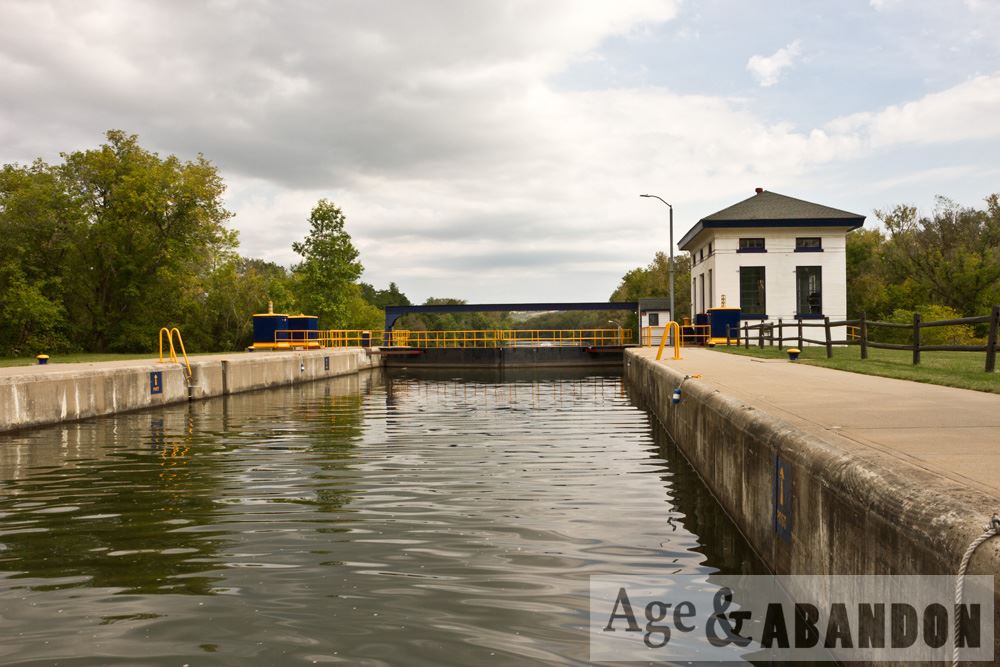 As the Erie Canal celebrates 200 years of use, it may not have gone through Victor, but Victor personages certainly had an impact on its success.
Information received from:
Consider the Source
Victor: The History of a Town by Lewis Fisher
“Bushnell’s Basin, Hamlet on the Erie Canal”, Andrew Wolfe
- Harlan Fisher, Victorwood Park & Now Harlan Fisher Dog Park
- Victor's Connection to Renowned Rochester Architects
Harlan Fisher, Victorwood Park and Now Harlan Fisher Dog Park Gene W. Fisher
By Babette Huber, Town and Village of Victor Historian
In June 2024, the Harlan Fisher Dog Park opened on Lynaugh Road. Who was Harlan Fisher and what is the history of this park?
Harlan Fisher was the name of the father of Gene W. Fisher. Gene Fisher was born in 1917 on a farm in East Bloomfield, NY. After graduating from high school, he attended Cornell School Of Agriculture and Syracuse University. After college he returned to the family farm for 12 years.
In 1950 he started a company known as GWF Homes Corp and obtained a franchise with National Homes, headquartered in Lafayette, Indiana, with a manufacturing plant in Horseheads, NY. Between 1950 and 1980, he built nearly 1000 homes in Ontario County.
Gene Fisher built and developed Victorwood, which is adjacent to the park. Originally begun in 1961, when the first building permit for the first housing development in the Village of Victor, was issued. It was developed for families who dreamed of housing that would be affordable. At the time, people could put down $99 and pay $99 a month to buy their home. As Mr. Fisher sold homes to families, he decided to set aside a six-acre parcel for the children to have a park in which to play. Gene Fisher credited his father Harlan A. Fisher for instilling in him the values of hard work. In memory of his father, he donated a parcel of land to the Village of Victor, now known as Harlan Fisher Park.
Victorwood streets were named so because Gene Fisher’s secretary at the time was from England and she suggested using the names of British titles for the streets - Kent, Tareyton, Ambassador, Winston, Somerset… Many of the street names became names of cigarette brands so Victorwood became known colloquially as “Cigarette Hill”.
Gathering input in 1993 the Village of Victor asked its residents what it would like to see as they thought about updating the park. The residents wanted to see a picnic pavilion, playground, wooded area and walking trails for the park.
Over sixty years after Gene Fisher made the park for children, it now includes a park for dogs. Mr. Fisher’s legacy continues as our furry pets now have a playground to enjoy thanks to Brian Emelson and the Department of Parks and Recreation.
Information for this article came from Dan Fisher and the Town of Victor Archives
c. 2024
- Barns of Victor
- QR Codes Are Now Coming to Victor’s Historic Markers!
- BAGEL is Not a Food! It's a Yearbook?
BARNS of VICTOR
By Wilma Townsend, Town Historian’s Office
Benson Farm 461 Benson Road
After returning from the California gold rush in 1856, Ichabod Benson bought this property from the Parks family. It has remained in the Benson family since then.
The red gambrel roof barn has a ramp to the center bay. Small sheds were added as needed. Note the 20th century silo that is no longer in use. The long gray barn in the foreground was built later in the 20th century.
Hawkins Farm 945 Victor-Egypt Road
This farm was first owned by William Hawkins, farmer and carpenter who built the nearby Italianate brick residence in 1865. The property has remained in the Hawkins family for five generations.
The Gothic Revival carriage barn with the center front gable has doors opening to wagon and carriage storage, and horse stalls. The left end of this barn has a small extension for a hay track to carry hay into the mow for the animals.
The barn to the left may have been for other agricultural activities such as preparing products for market and for storage. A substantial gambrel roof barn once stood across the road from the house and the smaller barns.
Loveland-McMahon Farm 1124 McMahon Road
Asel Loveland came to Western New York from Massachusetts in 1831 and settled his family on this farm in about 1840. After his death in 1899, the property was sold to the McMahon family.
This English barn with its cobblestone foundation probably was built in the 1840s. Gothic Revival elements such as the center front gable and the windows probably were added later in the 1860s. A shed extends along the back of the barn for animals and storage.
Wilcox Farm 1338 Strong Road
Born in East Bloomfield, Hiram Wilcox was working this farm by about 1850. Upon his death in 1891 the farm passed to his son Charles E. Wilcox.
The two attached gambrel roof barns that are built into the side of the hill have lower levels for livestock and other activities such as dairy. A gambrel roof gives 50% more storage for hay over gable-end English barns. Two former silos can be seen behind the smaller barn.
Ketchum Farm 1702 Murray Road
Born in Victor to one of the founding families of Victor, Albert Ketchum began farming here in about 1830. In 1866, he sold the farm to Graham Parmele. The Parmele family owned the property into the 20th century.
The gable-roofed English barn in the back may be original to the farm. The large gambrel roof barn with a silo peeking behind it and the smaller Dutch gambrel roof barn date to the early 20th century.
Lauder Farm 6381 Gillis Road
Coming from New Jersey, Samuel Snedecker began this farm in 1832. In 1855, John Lauder bought the farm and it has remained in the family since then.
The two English barns attached to each other may be the oldest in this barn complex. The smaller barn to the left has a cobblestone lower level with areas for livestock. The larger barn to the right was used for threshing and hay storage, with livestock underneath. The barn to the far left may have been used for various agricultural activities and storage. The barn to the far right is the newest to the complex.
Hunt Farm 7782 Dryer Road
Originally from Beverly, MA, Elston Hunt and his family were living in Victor by 1810. In 1820, he bought 81 acres for $325 and began his farm. His son Jared R. Hunt took over the farm upon his father’s death in 1841. The farm remained in the family into the 20th century. Jared’s daughter Lucie Hunt, married Frank D. Spring who continued running the farm.
The three bay English bank barn has a ramp (on the other side of the barn) to the main floor and a raised basement for livestock. The barn probably dates to the early to mid-19 century.
Lawrence-O’Neill Farm 7793 Boughton Hill Road
Lorenzo Lawrence came to Victor from Stockbridge, MA in about 1824 where he worked for others, rented a farm to save money and then bought this farm. After his death in 1894, the farm was sold to M. C. O’Neill.
The barn complex includes two gambrel roof barns from the late 19th century for hay and equipment storage with animal stables underneath. The 20th century Dutch gambrel roof barn to the right is made of concrete block and is attached to the smaller gambrel roof barn.
 Victor News, 1922
By Babette Huber, Town and Village of Victor Historian
The Victor Herald was Victor’s local newspaper from 1881-1991. One hundred years ago, the Victor Herald, in 1922, shares an historical journey of how different our lives are now. Along with national, state, and local news, two favorite columns were: “Around the Town” and “People You Know.”
1922 was in the decade of the “Roaring Twenties” -- a decade of economic growth and widespread prosperity, driven by recovery from wartime devastation and deferred spending, a boom in construction, and the rapid growth of consumer goods such as automobiles and electricity. It was marked by a general feeling of novelty and a break with tradition and through modern technology such as moving pictures and radio. Jazz-Age flappers flouted Prohibition laws and the Harlem Renaissance (an intellectual and cultural revival of African American music, dance, art, fashion, literature, theater, politics, and scholarship centered in Harlem, Manhattan, New York City) took flight.
Some national events which happened during 1922 were:
- Christian K. Nelson patented the Eskimo Pie ice cream bar
- President of the United States Warren G. Harding introduced the first radio in the White House.
- In the Bronx, construction began on Yankee Stadium.
- In Washington, D.C., the Lincoln Memorial was dedicated.
- Rebecca Latimer Felton of Georgia became the first female United States Senator
- The Molly Pitcher Club was formed as a women's organization to promote the repeal of Prohibition
Statewide in 1922 showed that:
- During the winter of 1921-1922, New York State was visited over a very wide area by so-called infectious or epidemic jaundice;
- Al Smith was elected governor;
- New York City requires by law that all “pool” rooms must change their name to “billiards” rooms.
In Victor, 1922, things were more subdued and conservative. For example, Victor initiated a new speed ordinance on Main Street - 15 miles per hour. On the first day, Officers Farrell and Waldorf, had caught eight speeders and Judge Ewer, after finding them guilty, collected $80 in fines.
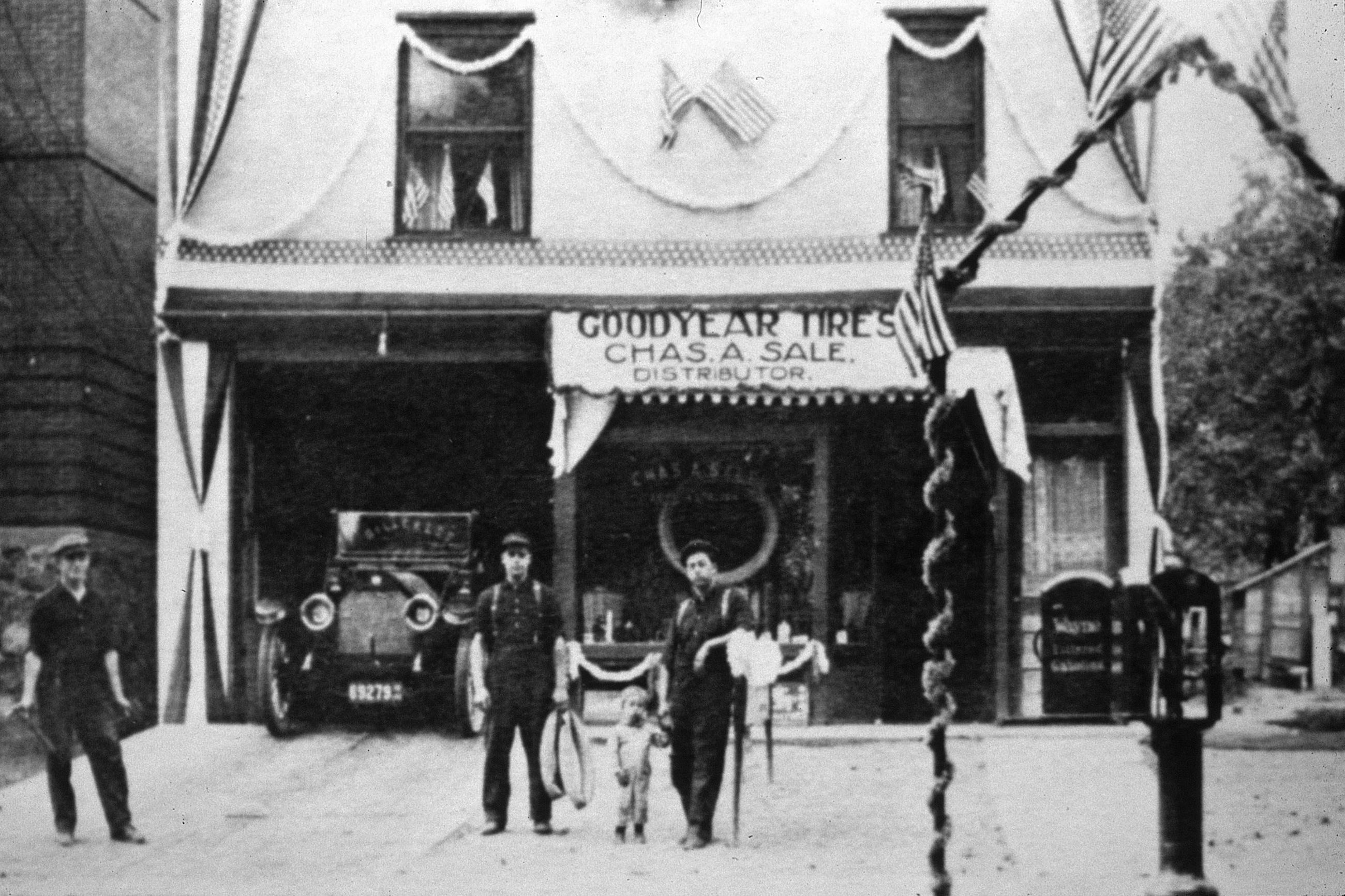
The Sale Garage (now where Pontillo’s is) had a 1922 Ford Sedan with an electric starting and lighting system on sale for $645. Sale’s advertisement boasted the greatest motor car value ever produced - an enclosed car of comfort, convenience and beauty.
Local trips were written with great detail! Mr. and Mrs. Henry Wielt, of Victor, went to Phoenix, Arizona in 19 days - traveling 2,916 miles, used 125 gallons of gasoline costing $33.79 (total!) and about 25 quarts of oil, costing $7.00. Other specifics included where they stopped, who they visited, what sight-seeing they did and what kinds of roads they encountered.
Under the weekly “People You Know” column in the Victor Herald, one would read, for example:
- The Misses Evelyn Tay, Mildred Lauder, Dorothy Gillis and Mary Gillis are spending a week at the Sale cottage on Canandaigua Lake;
- Mr. and Mrs. Ira A. Corey will have as their guests, Saturday, the ladies of the White Cap Club, formerly of Ionia;
- Mr. and Mrs. Harry Tourje of Syracuse arrived, Saturday evening, for ten days’ visit with Mrs. Tourje’s sister, Mrs. Guils Wilbur and family;
- W. C. Green and family spent Sunday afternoon at Letchworth;
- Reverend and Mrs. Lorren Stiles of Holly visited Mrs. A. G. Aldridge and family and other Victor friends from Wednesday until Friday.
It was important, at the time, apparently, to let people in the Town and Village know exactly what was happening in your household.
“Around the Town” was more of an announcement column in the Victor Herald. For example:
- School opens Tuesday, September 5th;
- Sylvester McCarthy has purchased a Maxwell touring car;
- A son was born to Mr. and Mrs. Albert Pezzimenti of Victor at Memorial Hospital in Canandaigua on August 18th;
- The Young People’s Society of the Evangelical Lutheran church will hold a sausage roast at the home of H. Czadzeck on School Street, this Friday evening;
- The residence of Mr. and Mrs. George W. Boughton on Maple Avenue is being improved by a fresh coat of paint;
- The 16th annual reunion of the Benson family was held Wednesday at the home of Alonzo L. Benson. Fifty-one members were present.
As you read about the happenings nationally, in the state and in the town and village of Victor in 1922, one hundred years has certainly changed our lives. It certainly was a simpler time. What would the Victor Herald say about its citizens in 2022?
QR Code Historic Village of Victor Business District
Use your smart phone or other mobile device to take a QR code walking tour featuring a number of significant historic buildings in the Village of Victor on East and West Main Street. The QR code will tell you the history of the building. Begin anywhere along the route - just look for the sign on the building.
The tour includes:
- Original Fire Hall, 5 West Main Street
- Simonds and Sons Cobblestone Store, 2 East Main Street
- The First Presbyterian Church, 70 East Main Street
- Original Presbyterian Church Parsonage, 90 East Main Street
- Victor Village Cemetery, behind the Methodist Church
- The First United Methodist Church, 106 East Main Street
- The First United Methodist Church Parsonage, 106 East Main Street
- The Henehan Block, 69 East Main Street
- The Jacobs Block, 61 East Main Street
- The Barnum Block, 57 East Main Street
- The Bristol Block, 37-39 East Main Street
- The Cobb-Prentice Block, 27-31 East Main Street
- The Goodnow Block, 23 East Main Street
- The Barber Shop Block, 17-19 East Main Street
- The Gallup Block, 1 East Main Street
- The Moore Building, 2 West Main Street
 Fishers, New York - Seed Potato Capital of the World
In the little hamlet of Fishers, New York, now part of the Town of Victor, potatoes were king! From the Civil War to well after World War I every available space was planted with potatoes. The sandy loam soil was the perfect earth in which to grow seed potatoes.
The boom all started in 1877 when the Valentown Grange sent Charles W. Ford to the Farmers Alliance convention in Morristown, NJ. The New Jersey growers were complaining about the difficulty that they were having keeping potato seed between seasons. Ford explained that the tubers grown in his area—that is, Fishers, NY, were very hardy and offered to send potato seed to anyone who wanted it. From then on and for at least 50 more years Ford sent seed potatoes to New Jersey.
Arthur G. Aldridge of Fishers had a warehouse with 50,000 bushels of seed potatoes and his catalogs went around the world. For years he had a photo of “the world’s largest potato”—a spud grown on his farm on Valentown Road the size of a pumpkin.
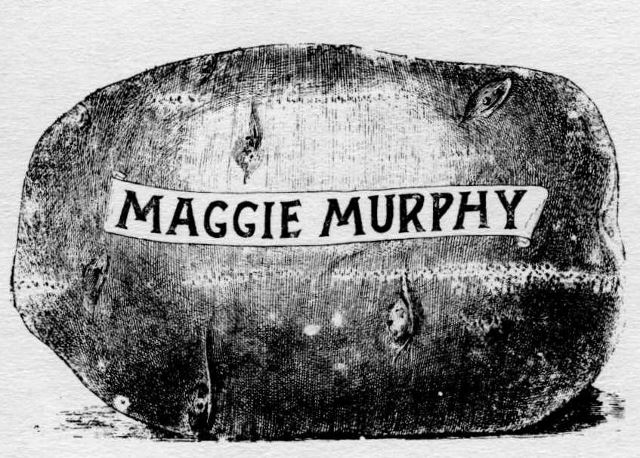
After the death of her husband, Sarah Connelly carried on the family business under the name of SJ Connelly because it was unusual for a woman to run a business at that time. She named one potato after her sister—the Maggie Murphy.
Ambrose T. Lane, another potato magnate exhibited 50 potato varieties at the Chicago World’s Fair in 1893.
The Victor Rose, Victor White and Brownell’s Best were some of G. B. Pickering’s seed potatoes that, as his catalog boasts, “ The potatoes we offer were grown in the vicinity of Fishers, Ontario Co., N.Y. … No other section produces more healthy or more vigorous seed potatoes.”
Noah Baker grew 10,000 bushels of potatoes a year on Baker Hill and was rated the single largest grower of seed potatoes in the United States.
And did you know that the land that Eastview Mall is built on used to be a huge potato farm?
Produce dealers, like Leslie Loomis in Victor, shipped, at its peak, 500 train car loads of potatoes a year. Big warehouses and freight houses stretched out along the Lehigh Valley and the New York Central’s Auburn Railroad tracks. Railroad Mills, Fisherville and Valentown also became shipping points.
With Fishers the potato capital of the world, it became one of the earliest areas to make use of the newly invented telephone. The Fishers telephone exchange was started in 1887 with eight outside lines.
Potatoes were so commonly grown that it was thought that the boom would go on forever. But today the sleepy hamlet of Fishers no longer grows seed potatoes—the Aldridge Warehouse was remodeled into offices for Lifetime Stainless Steel, but now the building is used by the Fishers Fire Department. Other storehouses, railroad stations and warehouses are gone.
The demise of the seed potato industry was the demand for lower quality seed potatoes grown elsewhere (more potatoes could be grown per acre with the lower quality) and the trucker who would buy right off the field, eliminating the middle man in Fishers who would act as the buyer. In 1950, with the last of the Aldridge family passing away in 1950, the glory of the seed potato industry in Fishers was gone. Today the rolling countryside around the Ontario-Monroe county border is home to Eastview Mall, other commercial endeavors, light industrial development, housing developments and the Thruway. Valentown Museum, as the original Victor/Fishers Grange, awaits the visitor to see the way things were in the heyday of the seed potato industry in Fishers.
Babette Huber, Victor Town Historian, 2013
Looking at Victor's Past
By Babette Huber, Town and Village of Victor Historian
The McCrahon Brothers—Union vs. Confederate
As the Civil War series continues, Victor had a unique family in which two brothers from the same family fought on different sides in the Civil War.
Alexander McCrahon of Fishers joined the 108th NY Volunteers in August, 1862, when he was 16. His brother, Edward, a salesperson for the old Ellwanger and Barry Nursery in Rochester was working in Louisiana in 1861 when he joined the 7th Louisiana.
Both brothers saw heavy fighting during the Civil War. Edward became an orderly for General Thomas Jackson (“Stonewall”) and fought in the Battle of Bull Run under him. Both brothers were pitted against one another at the bloody battle of Antietam. At Gettysburg, Alexander received a serious wound in the leg and Edward escaped unscathed.
Edward revered General Jackson and soon took on his nickname of “Stonewall”—presumably after Jackson’s death in 1863. At Rappahannock Station in late 1863, Edward McCrahon was taken prisoner by the Union Army. After three months he took the oath of allegiance to the United States and was released.
Alexander, after being wounded at Gettysburg, served out the Civil War and was honorably discharged in August, 1865.
After the war, Alexander McCrane (he changed the original spelling) worked as a railway employee in the West and in Mexico. He died on November 17, 1925, and is buried in the Soldiers Home National Cemetery in Washington, D.C.
Edward “Stonewall” McCrahon became an engineer on the New York Central Railroad. He married Margaret O’Connell of Syracuse and they had ten children. Edward died on August 24, 1918, and is buried in St. Agnes Cemetery, Syracuse.
The McCrahon Brothers family homestead is on Log Cabin Road, Fishers.
Information from:
Town of Victor Archives
Articles by: Father Robert F. McNamara, John M. McCarthy and Wilma Townsend
Babette Huber, Victor Town Historian, 2013
The Whistlestop History
The Whistlestop has been a business district ever since its early history. The New York Central Railroad which passed through Victor beginning in 1840 (and known then as the Auburn and Rochester Railroad) had a train station here (where Sequels is today), a hotel, produce warehouse, coal tower, water tower and flour mill. The flour mill, known as Victor Milling, was built in 1876 by Amos Scrambling. In 1890 the generator from the flour mill was hooked up by Fred Locke (“Father of the Porcelain Insulator”) to run an electrical line to his home to provide electricity for experiments and arc lights on Coville Street—which was adjacent to the Whistlestop area. The flour mill burned in 1937, but the two story section which was used to store the flour stayed intact. Today it houses Finn’s Tap Room Restaurant. The hotel was originally built by Chauncey Felt and became the Aldrich House, Covill House, Benson House and then the Insulator Hotel. It was demolished in 1946. The water tower was across the parking lot from the entrance to Finn’s and the produce warehouse was demolished but unknown when.
Babette Huber
Victor Town and Village Historian, 12.2.13